Wednesday, April 26, 2023

A Look Back (Part II)

After Christmas, I had the chance to visit my OMI priests and brother classmates at TICCS and Fr. Phanuel’s family (Executive Director of TICCS) for a New Year Celebration in the Volta Region of Ghana.

The Volta is located at the eastern part of Ghana. It is bordered on the East by Togo, on the West by the Volta River and Lake, Atlantic Ocean on the South, and Oti region to the North.

In order to reduce travel time, we took an alternative route to Kpando in Ho, Volta by taking a ferry from the Dambai Ferry Site.  The ferry is closer and has less traffic compared to the Tamale-Accra Road (12 hours land trip). The cost was also cheaper to cross the Oti River to Ho/Kpando. The loading and unloading of several cargo trucks into the ferry boat was a sight to behold.

Our Lady of the Grotto – Our Lady of Lourdes in Agbenoxoe in the Diocese of Ho

The first stop on our Volta excursion is in Agbenoxoe where the Our Lady of the Grotto – Our Lady of Lourdes is located. It is here on the largest artificial lake in the world - Lake Wolta in a small village named Agbenoxoe meaning “a place to live” in the local Ewe language that my OMI TICCS co-learners will serve the local Catholic community and look after one of the few Marian Shrines in Ghana.

This is a wonderful place.  One can immediately feel peace as soon as one enters its compound.  Truly a great place to meditate. The human size statues portraying the Stations of the Cross is worth the trip to this serene garden of peace.  There is also a larger-than-life statue of the Blessed Virgin Mary and St. Bernadette. We had a great time there.  The parish priest and the OMIs were gracious hosts.

Among the highlights of our stay in Agbenoxoe is a visit to a fishing village and a ride in a canoe around the lake and the midnight New Year’s Eve Mass at one of the parish’s outstation where a few children had their First Communion.  The joy of the people was palpable all throughout the celebration.

Wli/Agumatsa Falls

From Agbenoxoe, we moved to Fodome, Fr. Phanuel’s hometown. As expected, the family greeted us warmly and were most hospitable.  The 90-year-old patriarch of the family was a gracious host to us.

We were taken to the Wli/Agumatsa Falls the next morning. The Agumatsa Falls is the highest waterfall in Ghana and the tallest in all of West Africa located 20 kms from Hoehoe in the Volta Region. It is known locally as Agoomatsa which means, “Allow Me to Flow. It has a total height of about 80 m.  There are two waterfalls at Wli – the long fall and the short fall and both take different times to get there. To get to the short fall we had to hike for about 1 hour and 30 minutes if the walking pace is not fast and at least one hour if you walk a little quicker. To get to the long fall, we were told would take about 3 hours hike and climbing mountains.  To make the walk manageable, we decided to go for the short fall. The hike itself was exploratory as it was surrounded by rain forest. We got to see many species of butterfly, plants as wells as bats.  Even though the walk was long and the water cold, the falls did not disappoint.  It was beautiful, awesome, and magnificent.
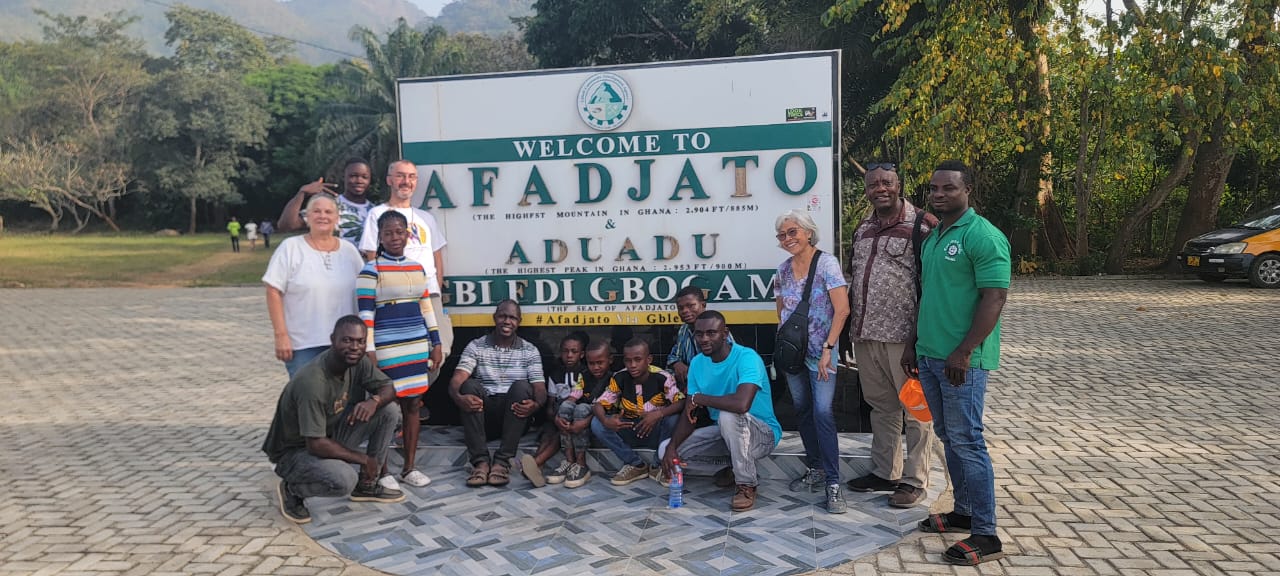

Mount Afadja

Mount Afadja or Mount Afadjato is one of the highest mountains in Ghana standing at an elevation of 885 meters (2,904 ft). ‘Afadja’ is the name of the mountain whereas ‘to’ in the Ewe dialect means mountain therefore, it is called ‘Afadjato’ by the locals.

The story is that when the indigenous people migrated to the area and saw the mountain it looked like the mound in which water yam is planted, water yam being called “Avadze” in Ewe. Moreover, there were some creeping plants on the mountain that resembled the water yam plant; they therefore called it “Avadze-to”. Today the word has been palatalized into “Afadjato”. It is unfortunate that none of us dared to take the mountain climb after the forest walk at Wli Falls.

Sacred Heart of Jesus Shrine at Fodome-Helu, Hoehoe, Volta

The Sacred Heart of Jesus Shrine at Fodome was the last stop on our Volta adventure before coming home to Tamale through Accra.  The Shrine is under the care of the Sacred Heart Parish of Fodome.   The environment is so serene, truly a place for prayer and meditation.  It boasts of giant-sized stations of the cross and of the course the giant statue of the Sacred Heart of Jesus.

The statue of Jesus from the ground to the crown is 15 feet long.  The outstretched arms are 8 feet and welcomes the pilgrim to the site, ready to embrace and bestow blessings upon him.  We learned that they used about 56 bags of cement to finish the statue. Other giant statues in the ground are the Immaculate Heart of Mary and the Divine Mercy. Truly a wonderful place to visit when in the Volta Region.

The Ghanaian People

Apart from these beautiful tourist spots in Ghana, it is the Ghanaian people’s beauty that stands out.  The claim that Ghana has a warm national character where visitors are welcomed as friends has once again proven to be true in our visit to the Volta region.


Wednesday, March 29, 2023

A Look Back

It has been a year since I boarded the plane at LAX bound for Ghana, Africa.  Accompanying me on this trip was Merton’s A Prayer of Unknowing (Blog 2) as a reminder that I do not journey alone.  I travel with Christ and with all the LMH Missionaries past and present through their prayer and support. 

So how has it been?  Is it everything that I thought it would be? As with any long journey, there are challenges and joyful moments.  In my previous blogs, I talked about some facets of the Ghanaian culture and what I have been doing. This time, as I look back on my first year of mission, I would like to share the beauty of Ghana and more importantly its people as I have been blessed to have travelled to the other areas of Ghana.

In July of last year, I was invited to attend the Thanksgiving Mass of the newly ordained priest of the Diocese.  The Thanksgiving Mass was held in Cape Coast, Ghana which is about 342 miles from Damongo where I live through Kumasi (bypassing Accra).  At Cape Coast, I was able to visit Beseasi, the hometown of Fr. Peter Akomanyi Tawiah where the Thanksgiving Mass was held.  Also in attendance was the other young priest ordained together with Fr. Peter, Fr. Fauster Baapele. It was a sight to see these two young priests atop a pick-up truck following a drum and bugle band to the Church.  The liturgy was celebrated mostly in the Fanti language.  As expected, there was much dancing during the liturgy.  


The Castle along with other slave castles in Ghana is a UNESCO World Heritage site since 1979.  The castle served as a timber and gold trading center for the British until the 19th century when it became the starting point of the trans-Atlantic slave trade. The dungeons of the castle housed huge numbers of African slaves destined for travel to North America.

At the museum, it was surprising to learn that the word “Obroni” as we are fondly called here to designate a ‘white person”, or a “foreigner” actually comes from the Akan phrase “abro nipa” meaning wicked person which was what the Ghanaian ancestors generally called the Europeans based on their general behavior back then.  This visit was a humbling experience for everyone including our Ghanaian brothers and sisters from the North.


St. Joseph’s Minor Basilica Church is a Roman Catholic Church in Elmina, Cape Coast. It was the first Roman Catholic Church established in Ghana in 1880 by Fr. Maru and Fr. Marat, Dutch Catholic priests who were the first to minister to the Ghanaians.  The place provided a blend of religion and history.  A Catholic museum is also located in the premises.

It is such an interesting place considering the time and place where it was built. It sits high on a hill where one can view the Elmina Castle (another slave trade fort) and bay. It is indeed a very beautiful location and a great reminder of how the faith has been kept and preserved and how from here the Church continues to evangelize to her children in Ghana.


Kakum National Park is located in the southern part of the Central region not too far from the coast.  This park is named after the Kakum river which starts inside the protected area. The landscape is about 90% tropical forest.  It features a canopy walk in the air through trees.  The walkway hits a heigh of 130 feet (40m) as it crosses rivers and ravines.  Some of the tree canopies reach a height of 160 feet (50m).  The trail stretches between 7 trees, cross rivers, and ravines a distance of 1,150 feet(350m).  Most people claim that the walkway is easy.  It is challenging for those who have a fear of height.  That day, I conquered that fear as I exited the trail, I got cheered on and received “high fives” from priests and the Damongo delegation.  Lesson learned:  we can do what we fear if we put our hearts into it and of course when you have no option but to move on.


More than these beautiful places I visited, Ghana’s beauty comes from its people, the welcoming smile, the kindness, ever willing to help and sincere hospitality.  The photos say it all.

In the next blog, I will take you to the South easterly region of Ghana, the Volta Region.


Wednesday, February 22, 2023

Welcome Mark

The LMH community in Damongo, Ghana officially became three (3) with the arrival of Mark McGraw.

Like every new arrival to the mission field, Mark was eager to immediately work in the Diocese of Damongo.  But as most of the veteran LMHers know, Africa, most specially Ghana moves in a much slower pace than we are accustomed to.

With the scheduled visit of the Bishop of Muenster, Germany, the focus of the Diocese was centered on this event since the Diocese of Muenster is a major partner in projects of the Catholic Diocese of Damongo.  Mark will just have to wait a little longer to find out his assignment.  

This turned out to be a blessing for us.  About 2 days from his arrival, our water pump burst, and he was there to fix. Since then, Mark has installed shelves in the kitchen, his bedroom and my bedroom. He has been busy writing his journal, something he might not find a lot of time to do when the work begins.  For now, Mark is settling in nicely, going for walks to the town center and just enjoying the hospitality of the Ghanaian people.

We are all excited for the contribution Mark will being to the Catholic Diocese of Damongo and the people of Damongo.  Welcome Mark, to your new home!


Tuesday, February 7, 2023

Christmas in Damongo

Earlier in August, I was told that there is not really any Christmas celebration happening in Damongo.  The faithful attend the Midnight Mass and the Christmas Day Mass and go home to their regular routine just like any regular day. That day I promised a few Ghanaian friends that we will celebrate Christmas in a special way this year.  We are going to have a Christmas party or gathering in my new home and possibly introduce the “exchange gift” practice we have in the United States

Preparations were tight for the event as I had to leave Damongo in October and upon my return move into the new house.  But I was determined to have the party so my friends and co-workers could experience the joy of a western style Christmas. Karen, the other LMH missionary assigned at the St. Anne’s Girls Senior High School helped a lot by preparing some food for the occasion, bringing the beer, and lending some tables we could use.  My colleagues at work helped me purchased the pork to cure and make the ham and ground pork for spring rolls to serve at the party. Another co-worker friend helped with the arrangements for the canopy, tables, and chairs rental.

Christmas Day lunch was ready after the Christmas Day Mass. Everyone came in their festive best.  The children were also dressed in their Sunday best.  Even the children from within the area of the house came to join the fun.  We had a surprise visitor that day – Chief Joseph, the chieftain of one of the local tribes came with his friend.  After the meal, we played the “elephant game” (thank you Karen for providing some of the gifts).  Goody bags were given to the children who were happy and grateful to receive them.

The highlight of the gathering was at the end when Chief Joseph spoke and thank everyone and said that they have realized that Christmas can be celebrated this way – joyful, united, grateful and with love.  He promised that he will continue to do what has been started and that a new tradition was born.  He even committed to host the next year’s Christmas party in his home.

I am grateful to have celebrated my first Christmas in Damongo with new found friends and to have shared a little piece of how Christmas is celebrated in the other parts of the world.


Wednesday, January 18, 2023

Witch Camp

Witch camps are settlements where women who have been accused of being witches can flee for safety in order to avoid lynching.  The witch camps appear to be unique to Northern Ghana even though Ghana shares with other African countries a common belief in witchcraft.

Why are there accusations of witchcraft?  In Africa and certainly in Ghana, everything has to be rationalized. They are not interested in the WHAT but the WHY. Everything must be explained, for that which cannot be explained results in uncertainty, so Africans naturally look at witchcraft for the unexplained.

The population of the witch camps is mostly women.  The women are often vulnerable, such as widows, older women, unmarried women who do not fit the stereotype that the society sees as suitable.  Communities often accuse women of witchcraft because they believe that they are guilty of conditions like bad weather, disease, livestock death, dementia, mental illness or appearing in another person’s dreams – circumstances which are beyond the accused’s control.  Children occasionally accompany these women to the camp in order to protect them, but these children suffer greatly from discrimination, lack of access to education and insufficient food and water. Majority never see their families for fear of being accused and ostracized themselves. The accused are completely cut-off of familial ties.  But when a victim dies, the family will show up to transport the body home for burial and funeral rites.

A person suspected of witchcraft is sent to a witch finder or traditional priest to undergo rituals to confirm who is a witch and exorcise the spirit of witchcraft.  This is often a trial of ordeal.  Some of the methods employed include but not limited to are:

Ø  putting the hand of the accused in boiling oil; if the person is harmed, he/she is a witch

Ø  at Gambaga camp, the accused, and the complainant both send a chicken to be sacrificed to the gods; innocence or guilt is established by the final posture of the chicken when it dies – a chicken that dies with its face down means the accused is guilty of being a witch.

Ø  putting a cord around the neck of the accused; guilt or innocence is determined by the position of the accused when she falls as the cord is pulled

Ø  tossing a cola nut in the air; again, depending on the way it falls, guilt or innocence is ascertained

Ø  in some cases, the accused are forced to drink a potentially fatal “cleansing concoction” that include chicken blood and earth


More often than not, the alleged witches will admit to the crime just to save themselves from these trials.

Currently, there are five witch camps in Northern Ghana:  Gnani Camp near Yendi, Kukuo Camp near Bimbilia, Gambaga Camp, Kpatinga Camp near Gushegu and the Gushegu Camp. Observers have relayed that conditions in the camps range from terrible to desperate.  Churches, NGOs send aid from time to time, but these are not regular.  The accommodation in Gushuego is good, thanks to the SVDs of the Roman Catholic Church.  But victims have to feed themselves from spilled grains gathered from the ground in local markets.

Below are photos of the witch camp in Gushegu taken during our visit to the camp.  A video of the song and dance presentation by the alleged witches for our group is also attached.  In the video, you will see the Carmelite priests and I join them in solidarity.

The SVDs are presently seeking grants to help the victims of witchcraft accusation.  The immediate goal is the education of the youth who are involved in the lynching activity instead of the relocation of these vulnerable women or the closure of the Gushegu Camp as proposed by the government.  While the ultimate goal is to eliminate the need for the witches’ camp, it is crucial to first change the hearts and minds of people through education, understanding and inspiration towards the values they care about, i.e., the Ghanaians’ deeply held communal values of family and respect for the elderly. 

“You can’t go back and change the beginning, but you can start where you are and change the ending.”

                                                                                                                                       -C.S. Lewis


Tuesday, December 20, 2022

New Home

I finally moved into the house for LMH missionaries in town.  It makes the travel to and from work easier. 

To reduce spending on a few essential things for the house, I had to be a little more creative than usual.  I actually fashioned a small table to hold the remote controls and cable box out of boxes.  The tabletop was the box the TV came in and the foot base was the box for the oven toaster that I bought.  Cover with wallpaper material and I now have a functional table.

This Christmas I, together with Karen will be hosting a Christmas lunch for our co-workers and neighbors.  To make the house more festive, we needed some decorations.  With limited holiday decorations at the nearest town (Tamale which is 2 hours away), I created some beautiful Christmas decorations using recycled materials. 


Now, I am being asked by the local people to teach them how to make these decorations.  Tomorrow (12/20), I will be teaching the Catholic Guest House Manager and some of her staff to make the decorations for the Guesthouse Restaurant.  They are all excited and happy that they will be using plastic materials that are normally just thrown away. 

Maybe next year, we can start earlier or even do some decorations for Easter.

Merry Christmas to all.  Thank you for the support you have given me this year and I look with joyful expectation for the coming year.

Tuesday, September 20, 2022

Visiting Some Tamale Institutions

 In the afternoon of the first day of classes at T.I.C.C.S., we visited some Catholic institutions in Tamale.  Since TICCS was established by the SVD fathers in 1983, it was not a surprise that the first institution we visited was the SVD formation house and seminary.


When we visited the SVD formation house, I met an Indonesian priest who lived with Fr. Alex Sila, SVD, parish priest of the St. John the Evangelist Parish (next to our Mission House) in seminary. Fr. Bernard, SVD (Fr. Alex’ junior) and Fr. Alex have not seen each other since they left their formation in Timor, Indonesia. It was good to help them connect once again. 

Another interesting story from this visit was that the last Superior of the SVDs in Tamale was a Filipino. Since I am a dual Fil-Am citizen, this was a surprise that a Filipino priest would be in Northern Ghana. A picture of the beloved Superior of the SVD who passed away in 2021 during the COVID crisis hangs in the SVD’s receiving hall. I also met a Ghanaian priest who studied for seven years in Manila at The Royal and Pontifical University of Santo Tomas, Manila, a Dominican university which prides itself as the oldest existing university in Asia and the largest Catholic university in the world in terms of population. We had an exceptionally long discussion on current events in the Philippines including the upcoming elections. He told me that he still follows events happening in Manila.

That day we also tried to visit the Carmelite nun’s monastery but they were in prayer so we could not go down and meet them.  Instead, we drove through the outstation parish that our Carmelite priests from Nigeria will take over and convert into a full fledged parish.  It is called the Holy Trinity Parish in Kukuo Tamale. 

We visited the Cathedral of Tamale, the Our Lady of Annunciation Cathedral.  Note that in the altar of the Cathedral is a noticeably big umbrella over the Bishop’s chair.  This is a traditional design; the Chief when in the presence of his people would have a big umbrella over his head. Inside the Cathedral is the final resting place of a beloved Ghanaian cardinal, Peter Cardinal Poreku Dery. A former Archbishop of Tamale, he is credited with the Africanization of the Catholic Church in Ghana and Africa generally because he composed the first local translation of the Mass in Dagaare.  The cause for his canonization commenced in mid-2013 and the late cardinal is now referred to as a Servant of God.  Did you know that our LMH Program Director, Janice England, has a picture with the late Cardinal?  It is so cool to show your picture with a future Saint. The Cardinal Dery Memorial Center is located just a few steps from T.I.C.C.S. It also serves as the pastoral center for the cause of his canonization.


The Cathedral has a separate adoration chapel within the Cathedral Area and a bookstore. There is a running joke among the learners that more often than not, we were adoring across the street.  The Cathedral was situated just across where the KFC fast-food restaurant of Tamale is located.

These are but a few of the Catholic Institutions around Tamale.  It is truly astonishing how these institutions have stood the test of time but even more inspiring are the people that make up this Church we call Catholic.

 “We don’t fly solo in the Christian adventure; we have brothers and sisters, and our personal story forms part of a much bigger story of salvation.”

John Bartunek, A Quiet Place


A December To Remember

As I count the months before I leave Damongo, each event, each encounter and activity have more significance. A Carol’s Night December t...